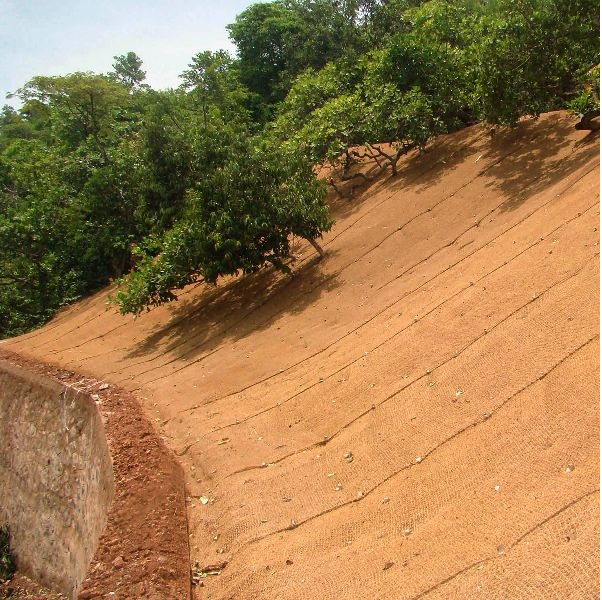
Coir geotextiles uses – One of the most effective and natural techniques to prevent soil erosion is using coco fiber geotextiles (woven geotextiles). Geotextiles are widely used in order to avoid environmental degradation and contain no synthetic materials. Instead, they are made from organic coco fiber extracted from a coconut’s husk. It is robust, durable, and waterproof and is one of the few saltwater-resistant natural fibers.Coir is spun or woven into net-forming products such as coir net, coir mat, geotextile, geoblanket, coir bed, coir pot, coir disc, etc.
These products are used for many purposes, e.g., B. protecting stream and river banks, stabilizing slopes in cuts and embankments of railroad tracks, sediment control, strengthening dirt roads, railroads and storage areas, filtration in road gullies, waste protection and forest reforestation. Vegetation, UV protection for underground crops, green roofs and landscaping, wind erosion control, soil erosion control, wetland environment, hardening of concrete pillars, and soundproofing and reclamation conditions of mining sites.
The use of geotextiles goes back a thousand years. Its fabric is designed and selected according to the most suitable application since it is available in different qualities and meshes. The lighter grades of coco coir geotextiles are used for rapid soil erosion and average soil conditions. In contrast, heavier coir geotextiles are used for embankments, slopes, or vegetation. Coir geotextiles protect the ground until vegetation permanently covers its meshes.
Coir Geotextiles uses to Preventing Erosion and Soil Sediment
It gives plants plenty of room to grow and naturally breaks down into humus, enriching and nourishing the soil. With a two to five years lifespan, coir has several unique properties compared to other natural fibers, such as jute, which is also used to control soil erosion. Coir geotextiles are good water absorbers, and geotextiles can hold water three times its actual weight, eliminating the need to water plants frequently. At the same time, with its sufficient space in the mesh, it quickly drains excess water, preventing water from pooling.
With a simple installation method, coir geotextiles require no chemical treatment as they allow in the right amount of air and light for a more deeply rooted plant. It can also withstand animal and human movement, causing environmental degradation.
Studies have proven that coco geotextiles are much more efficient, cost-effective, and environmentally friendly geotextiles. In a 1998 study of coir geotextiles, Schuerholz found that coir retained 20% of its strength a year later when tested in an incubator with soil and 90% humidity, while jute fully biodegraded after eight weeks. Another study conducted in Kerala, India, in 2005 with a farming community found that coco coir combined with local grass more effectively prevented soil erosion. Fiber degradation contributed to vegetation, and geotextiles were less expensive.
Soil erosion is an unavoidable environmental hazard worldwide. So why not use a convenient, easy-to-use, affordable and eco-friendly product? Coir geotextiles are the best choice as they provide better results and productivity, eliminating slippery slopes for good.
Maybe you like to read the following article Reinforcement Riverbanks and Coastal Area Using Coir Roll Matting