
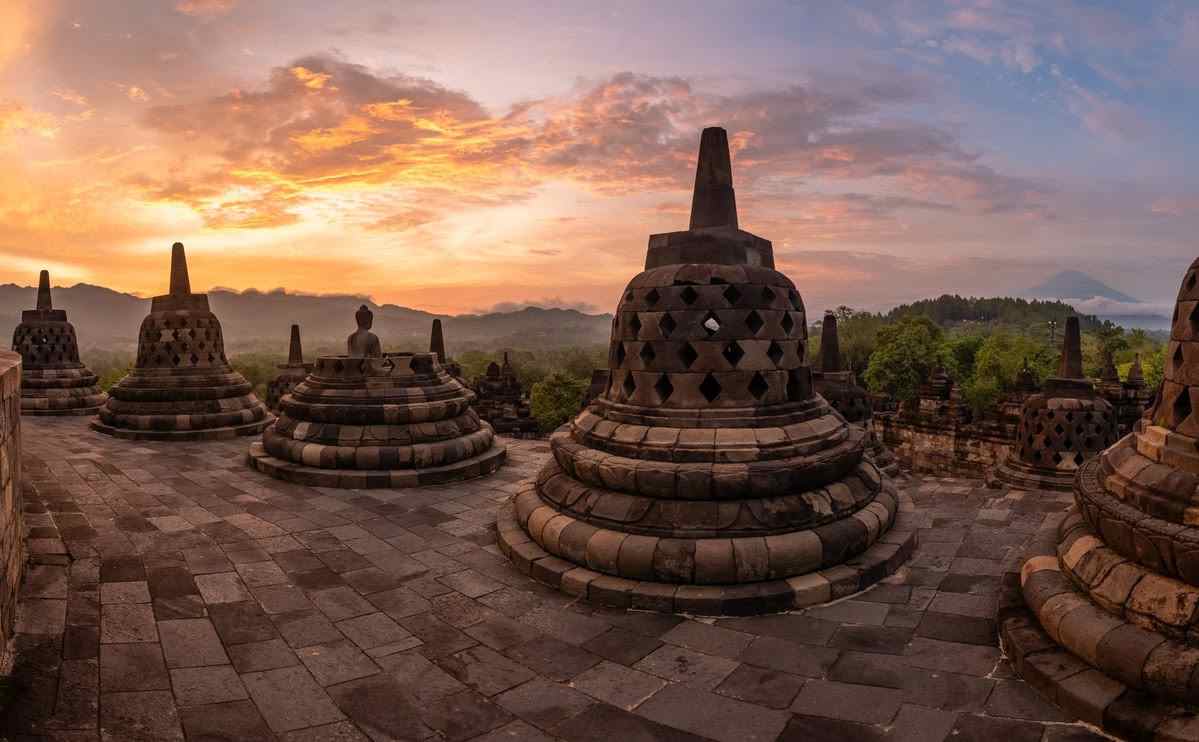
The Borobudur temple levels form a carefully organized architectural journey from the lower terraces toward the monument’s highest central stupa. Each section has its own visual characteristics, including reliefs, Buddha statues, stupas, and open platforms. Understanding these levels helps visitors appreciate the relationship between Borobudur’s architecture and Buddhist philosophy.
How Many Levels Does Borobudur Have?
Borobudur is commonly described through its three major architectural zones rather than simply counting every terrace as a separate symbolic level. These zones are associated with Buddhist cosmology and are represented through the monument’s changing architectural forms.
The lower section contains the square terraces and extensive reliefs. Above them are additional square galleries, followed by circular platforms at the summit.
This arrangement creates a gradual transition from detailed stone carvings toward simpler architectural forms.
The Lower Level and Hidden Base
At the bottom of the monument is the original base, much of which became concealed beneath additional stonework. This section contains a series of reliefs that provide insight into Borobudur’s early architectural design.
The visible lower structure then rises above this concealed base. Its extensive carvings introduce visitors to the monument’s narrative and religious themes.
Although the hidden base is not part of the regular visitor route, it is an important part of understanding the monument’s complete structure.
The Square Gallery Levels
The main square levels contain galleries surrounded by carved stone walls. Visitors walk around these terraces while observing relief panels and Buddha statues positioned throughout the architecture.
Stairways connect the different levels, allowing visitors to gradually climb toward the summit. Each gallery provides new perspectives of the monument and its surrounding landscape.
The extensive reliefs also make the square levels particularly detailed. Scenes depicting Buddhist stories, people, animals, buildings, and other subjects cover sections of the gallery walls.
For a more detailed look at Borobudur’s structure and the spaces visitors encounter throughout the monument, this Borobudur inside guide provides additional context.
The Circular Upper Levels
The architecture changes significantly above the square terraces. Three circular platforms form the upper section of the monument.
These platforms contain rows of perforated stupas surrounding the central stupa. Compared with the lower galleries, they have fewer carved surfaces and create a more open atmosphere.
The circular arrangement also produces a strong contrast with the geometric square terraces below.
The Three Symbolic Realms
The Borobudur temple levels are commonly interpreted through three Buddhist realms: Kamadhatu, Rupadhatu, and Arupadhatu.
Kamadhatu is associated with the realm of desire and is represented by the lower section. Rupadhatu, or the realm of form, corresponds with the square terraces containing galleries and reliefs.
Arupadhatu, the formless realm, is represented by the circular upper platforms. The architecture becomes increasingly simple as visitors move toward this highest zone.
Experiencing the Levels During a Visit
Walking through the different levels allows visitors to experience the monument progressively. The lower terraces provide detailed carvings and enclosed pathways, while the upper platforms offer wider views and repeated stupa patterns.
This physical progression is one of the most distinctive aspects of Borobudur. The monument encourages visitors to experience its architecture through movement rather than simply viewing it from outside.
Travelers interested in discovering Borobudur and other cultural destinations in Central Java can explore more through Borobudur Tours.
Understanding the Borobudur temple levels adds context to every stage of a visit. From the detailed lower galleries to the open circular platforms, each section contributes to the monument’s architectural and spiritual character.
